


Uneven AI adoption across gender and age groups is already creating performance disparities in the workplace - and without deliberate intervention, it risks entrenching existing inequalities.
That was the central finding from a roundtable hosted by Matchtech, bringing together HR, Procurement and Engineering leaders to explore how AI is reshaping inclusion at work.
Facilitated by our partner, Ursula Tavender from Innovationin, the roundtable went past the tools and tech hype to look at the big picture:
how AI is already reshaping work, roles and talent pipelines, and how uneven adoption could already be exacerbating embedded inequities.
Whilst there are well known concerns around AI and inclusion – with examples of discrimination by AI in recruitment, healthcare and the justice system – one key area emerged which is already impacting individuals everywhere.
AI adoption is not neutral.
The AI-adoption gap explained
The stats clearly show that younger workers are adopting AI faster than older workers. On top of that, even in the youngest cohort, men are embracing AI at higher rates than women; a gap that increases with age.
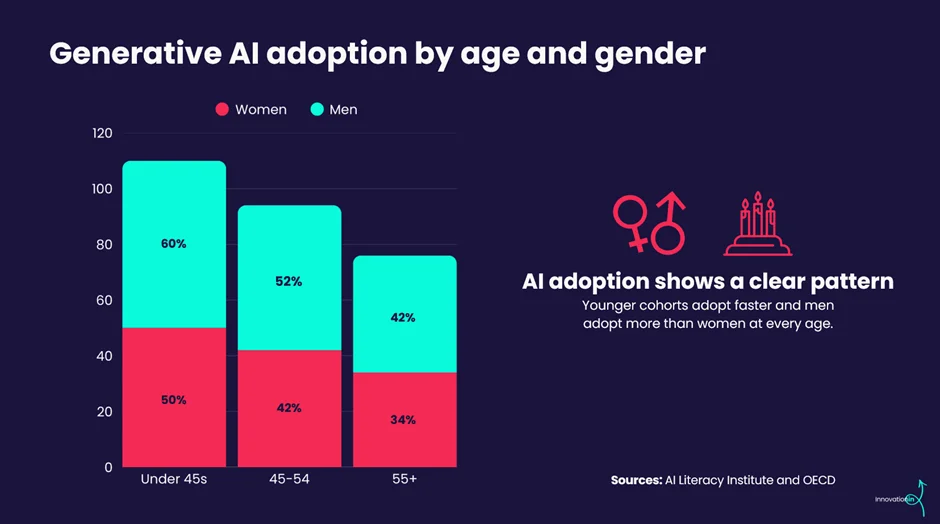
Uneven AI adoption is already happening. And, in the new age of work, if AI literacy is the key to individual productivity, uneven adoption will create unequal performance, which will only exacerbate imbalanced progression.
In the new age of work, uneven adoption = unequal performance = imbalanced progression, exacerbating current inequities.
Our roundtable explored how some of the systemic gender dimensions at play in the workplace could be impacting AI adoption.
As attendees shared experiences, some key barriers to AI adoption emerged: clarity, confidence, capacity & credit are playing a key role in preventing uptake.
BARRIER 1: Clarity & confidence in AI exploration
Studies suggest factors like daily 'microaggressions' alongside unfair workplace scrutiny, performance standards and progression pathways leave women feeling they have less latitude to take risks when it comes to new tools or ways of working. Feeling under greater scrutiny, many women undertake careful cost-benefit analysis on their tasks, with greater risk aversion to non-core tasks with unclear ROI, like AI exploration.
Without senior sponsorship and clear corporate strategy, those feeling exposed to greater scrutiny and repercussions will stick to what’s safe, potentially avoiding tasks or tools not clearly endorsed by management.
This means, without complete clarity and mandates to equalise AI exploration across all employees, self-directed AI adoption programmes that rely on experimentation and tolerance of failure could disproportionately disadvantage women.
What can leaders do?One of the most powerful levers discussed was clarity. When leaders clearly communicate why AI is being adopted, how it will be used, and what remains human-led, employee confidence and engagement more than doubles. Clarity reduces fear, levels the playing field and enables broader participation across roles and demographics. We also talked of empowerment. One attendee raised the idea of ‘AI-shame’; the feeling of not knowing or upskilling themselves enough reinforcing reluctance to start. Ensuring every employee has access to AI isn’t enough. Giving them the clarity and encouragement to explore them in work time will help equalise adoption. |
BARRIER 2: Capacity for self-directed AI adoption
One participant shared they felt that, as the only woman in senior meetings, notetaking responsibilities were inevitably deferred to her due to her gender. In this case, they felt AI was reducing the time impact of such assumed responsibilities through automated notetaking and actions distribution, enabling her to focus on more valuable work. This could be a benefit of AI and automation on tasks driven by gender-bias.
But, for many women, the impact of what Rosabeth Moss Kanter coined as ‘office housework’, could be reducing discretionary time to explore AI or limiting their use cases.
Books like ‘The No Club’ suggest women spend 200 hours more than men per year on such ‘non-promotable tasks’, having a huge impact on workload and capacity to explore tools outside their core daily tasks.
What can leaders do?Explicitly permit and encourage scheduled time for your teams to explore AI, in work time. Don’t just wait for them to do it. We discussed business-wide training initiatives, but also the concept of corporate commissioning of carved out exploration time. Establishing scheduled ‘AI-play’ sessions could help equalise the time spent by employees on upskilling, allowing those with the strongest subject expertise in their own roles and domains (the employees themselves) to understand how AI could best complement their work. Additionally, implementing business-wide AI administrative support might reduce the impact of unfairly allocated ‘busy-work’ burdening some women in the workplace. |
BARRIER 3: Claiming credit for AI success stories
Research on technology self-efficacy suggests men are more likely to describe themselves as proficient with new tools earlier in the learning curve, which makes them more visible as "AI adopters" in the organisation. They’re also more likely to champion their own use cases internally and take credit for success.
Unequal self-promotion can become self-reinforcing - attracting more opportunities, training, and greater latitude to keep experimenting for those who are already ahead.
This self-reinforcement also works both ways. Those who shout about their success will benefit from positive reinforcement and recognition. Those who don’t may end up in the ‘AI-shame’ spiral, reducing appetite to explore because others seem further ahead than they actually are.
What can leaders do?Create equal platforms for measuring AI proficiency and championing successes! Ideas discussed include:
|
Thinking bigger: Deliberately redesigning work for inclusion
Ultimately, if adoption is accelerating at speed, businesses have to shape how. And those who do this deliberately to build a more diverse workforce will have a greater access to skills.
The corporate experience shared by our attendees was varied. Most organisations were already aware of widespread use, but largely left to individuals with openAI platforms. A minority had already restricted use, invested in their own private technology and only allocated access following structured training.
Whilst there’s a need to communicate clear strategies, equal access and corporate approaches to AI upskilling, it’s also important to recognise that AI will itself reshape the world of work. And in this lies a huge opportunity for inclusion.
McKinsey’s Eric Kutcher says, ‘this is probably the biggest and most complex business transformation – but it’s 80% business transformation and 20% tech transformation’.
AI’s revolutionary capabilities are forcing businesses to redesign role profiles, career pathways and performance signals to blend human and AI expertise.
The opportunity to deliberately redesign organisations offers a once-in-a-lifetime chance to embed inclusion into our working systems, supporting more flexible working patterns and more tailored human roles that play to each individual’s diverse strengths.
Key Takeaways: AI, Adoption and Inclusion at Work
The adoption gap is already here. Research shows younger workers are adopting AI faster than older colleagues, and men are adopting faster than women across all age groups. Left unaddressed, this creates a compounding cycle: uneven adoption leads to unequal performance, which leads to imbalanced progression.
- Three barriers are driving the gap.
Clarity and confidence to experiment, capacity to explore beyond core tasks, and credit for early adoption are the three key factors disproportionately limiting AI engagement among women in the workplace - each reinforcing the others.
- Self-directed adoption programmes are not enough.
Without deliberate leadership intervention, organisations that leave AI exploration to individuals will inadvertently favour those who already have more latitude, time, and confidence to experiment.
- Leaders have practical levers available now.
Communicating a clear AI strategy more than doubles employee confidence and engagement. Scheduling protected exploration time and creating equal platforms to celebrate AI use - at every level - can meaningfully level the playing field.
- AI transformation is an inclusion opportunity, not just a risk.
The need to redesign roles, career pathways and performance frameworks around human-AI collaboration offers organisations a rare chance to build inclusion into the foundations of work - rather than retrofitting it later.
Hear from our attendees…
“The learnings I took from it were around the difference approaches women and men take towards AI and particularly how that may affect the STEM applications, also the way performance management may need to evolve to take AI into account.”
Senior Category Manager
“That was one of the most thought provoking sessions I’ve attended in a long time. Such an important and expansive topic.”
Group HR Director
More about Innovationin
Innovationin are a people transformation partner helping businesses navigate the a world where AI, hybrid work, and career shifts are reshaping the landscape, to help bring out the best of their biggest asset: human potential.
Connect with Ursula to discuss practical next steps for your organisation as you embrace a people-first approach to AI transformation, you are warmly invited to connect with Ursula. (https://www.linkedin.com/in/ursula-tavender/ and ursula@innovationin.co.uk)