Finding Talent in Unexpected Places
27 Oct, 2026




 Two people, one gap
You’ve spent years building skills the country can’t do without. Software that has to work the first time. Systems that keep critical equipment running. Designs that go from screen to production line.
Then the role comes up. Right programme, right team, right next step. It’s also three hours up the motorway. Somewhere else, a hiring manager is looking at the same role from the other side. The programme is moving, the vacancy matters, and the local search keeps coming back short.
For the engineer, the motorway is often where the conversation ends.
The employer, the thin shortlist is where it stalls.
Both reactions are understandable, and both are worth a second look. I’m not here to tell anyone to move. Plenty of people shouldn’t.
Every week I talk to engineers who rule out the right role before they’ve looked at what a move would involve. I also talk to employers wondering why the right people never apply. At Matchtech, alongside our sister brand Infosec People in cyber security, we work with both sides of that problem.
The decision always stays with them. Our job is to make it an informed one.
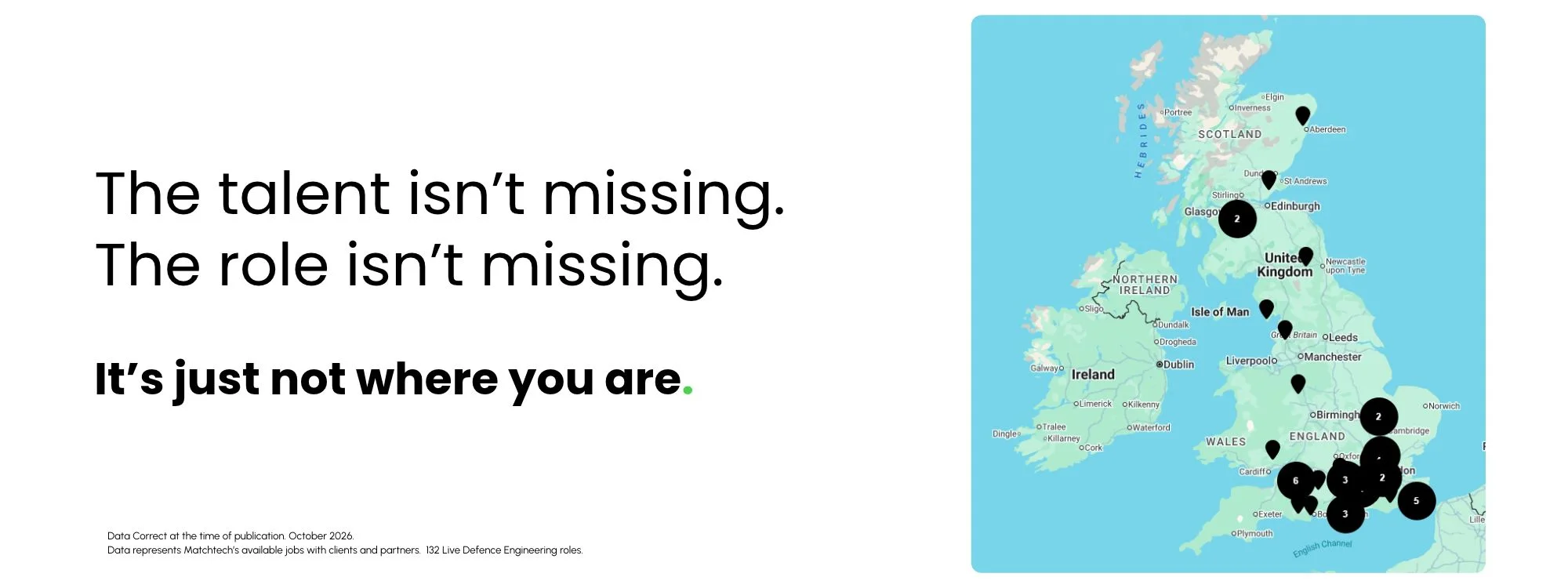
Why the work sits where it does Defence isn’t spread evenly across the map. Programmes grow around shipyards, airfields, test sites and secure facilities, and the skills follow. In 2023, almost a quarter of the UK’s defence workforce (24.4%) was based in the South West, against 9% of all UK employment.
Skills England and the Ministry of Defence project that the sector’s 14 priority occupations will need around 53,000 more people between 2025 and 2035. Once you include replacements for people leaving, that rises to about 82,000.
Software developers top the list, at roughly 17,200. These are projections and could change, but half of those occupations are already in critical or elevated demand (Source: Skills England, Sector Skills Needs Assessment: Defence, updated October 2026).
So some of the most important work happens in places you might not have pictured. There’s the naval heartland around Portsmouth, the cyber cluster around Cheltenham, and the engineering hubs of Hampshire and Hertfordshire. There’s also coastal Cumbria, home to some of the most complex engineering in the country, with the Lake District on the doorstep.
Water, rail and energy are chasing many of the same engineers:
Water needs an extra 43,700 people by 2030 (CIWEM, Your Future, October 2025, drawing on Energy & Utility Skills figures).
Rail could lose up to 70,000 workers to retirement and other attrition by 2030.
Clean energy: the government expects employment to roughly double, to around 860,000, by 2030.
Infrastructure gets built where it’s needed, not where the talent already lives.
The doubts on both sides When I raise relocation, candidates often give me the same four answers. All of them are fair, and none of them has to end the conversation.
“I don’t want to move.” Fair enough. If you’re ever curious, it’s still worth knowing whether a role is hybrid or fully on site.
“I’ve got family here.” This is the big one, and I’d never brush it aside. It doesn’t have to be a flat no, though. A contract role can let you get to know a place before anyone uproots, and some people work away during the week before deciding. Sometimes the honest answer is that now isn’t the time. Either way, it should be your call.
“I can’t afford it.” Some employers contribute to relocation costs. Where the conditions are met, HMRC treats up to £8,000 of qualifying relocation expenses and benefits as exempt from tax and National Insurance. What’s on offer varies, so ask.
“I wouldn’t know where to start.” That’s the easiest one to fix.
Here’s something I notice often. People who’d hesitate over Cumbria will happily talk about Dubai, because it feels like an adventure rather than an upheaval. The UK deserves the same open mind.
Employers have doubts too. Will someone really move for this role? Will they settle once they’re here? Can we compete with what’s on their doorstep? There’s no magic answer. Each question gets easier, though, when the move is talked through properly before an offer is made.
Someone who has weighed up the location, the working pattern and the support is making an informed choice, not a leap.
Finding someone who knows the road When you talk relocation with a specialist consultant, you should come away with:
A straight view of the location, including what life looks like beyond the site gates.
Clarity on how the role works, whether that’s hybrid or fully on site.
Someone in your corner on the offer, negotiating for you and asking the relocation question so you don’t have to.
A clear picture of clearance. Most defence roles need Security Check (SC) clearance. Your employer sponsors it, so you can’t apply on your own. We’ll explain what’s involved before you commit.
For employers, the answer is to widen the pool to people who’d move for the right role. That means telling them the honest story of the role and the place, then supporting them through the decision so the offer lands.
That takes more than posting a job and waiting. Leonardo Cyber had spent 12 months with limited success filling 10 critical cyber roles. With a small, dedicated team of our specialists alongside them, all 10 were hired in six months. BAE Systems has worked with us for over 30 years, with more than 500 placements a year across programmes from Type 26 to Dreadnought.
For the engineer, the end of the road isn’t always a removal van. It might be a move, a decision to wait, or a contract role to test the water. For the employer, it’s a shortlist that isn’t limited by postcode.
A conversation isn’t an application, and it isn’t a commitment. It’s a chance to see what’s out there and what support might be on the table.
Weighing up a move, or hiring for a site that talent doesn’t naturally find?
Message me, kayla.hopwood@matchtech.com or my colleague adam.rymell@matchtech.com, if you're exploring opportunities outside of Defence and Security email info@matchtech.com.
Find us on LinkedIn
The right people, in the right place, at the right time. Sometimes getting there just takes a move.